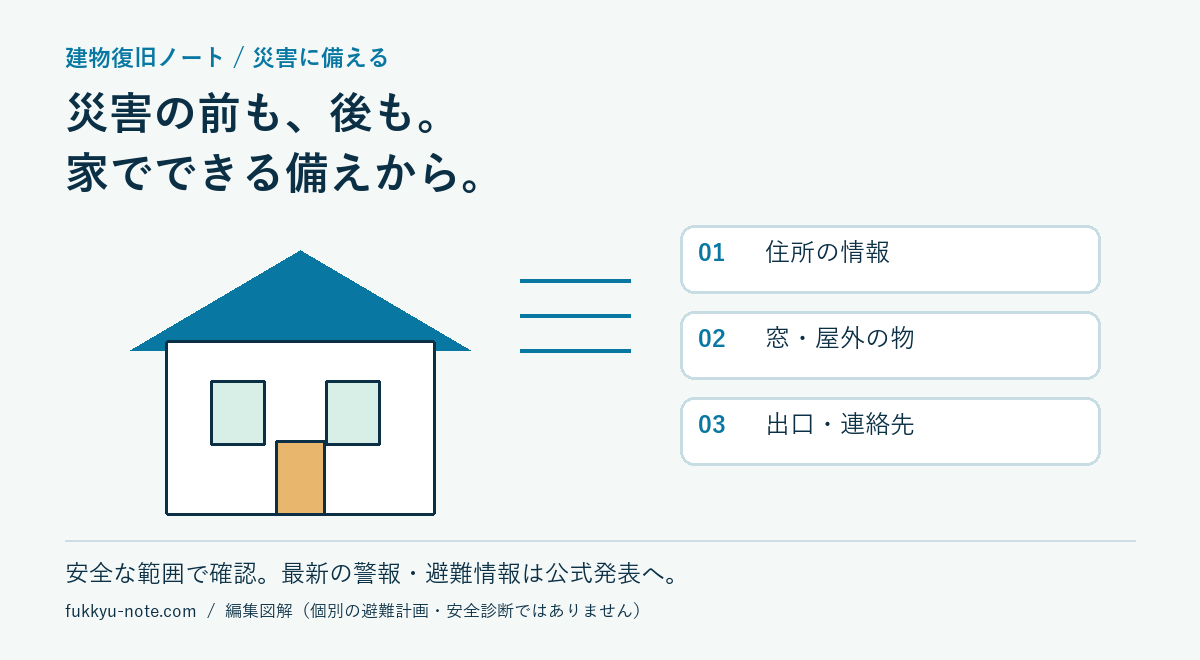
Before buying disaster supplies, check what could happen where you are, where to go if danger rises, and whether routes inside your home are blocked. This is a starting point for organizing preparations before a disaster as well as repairs afterward.
Two practical ways to prepare
- New disaster supplies for homes in Japan
Decide what to stock at home and what to carry if you have to leave. - Set up official disaster alerts in Japan
Save English weather warnings and keep your evacuation route available offline.
After typhoon news, is the track map the only first check?
Do not judge risk from the forecast track’s centerline alone; check current JMA and municipal evacuation information. Combine your address, terrain, and building use to select preparations.
Before rain and wind intensify
Check windows, outdoor items, safely reachable drains, and contacts. Do not climb onto roofs.
Follow the steps for typhoon preparationIf you are concerned about earthquakes
Check sleeping places, furniture, exits, and family contact methods. Do not tidy during shaking.
See indoor safety prioritiesPreparedness suited to the area
Separate checks for coasts, rivers, slopes, and apartments.
How to find information using your addressWhat needs checking differs even within the same city
| Home conditions | Information to check first | Decisions to make beforehand |
|---|---|---|
| Near the coast or a river mouth | Check storm surges and tsunamis separately. Do not approach the coast to look. | Designated municipal emergency evacuation sites and safe routes. |
| Riverside or low-lying land | River or surface-water flooding, rainfall and local evacuation information. | Can you move before dark? Prepare for family members needing more time. |
| Near slopes or cliffs | Landslide zones, Kikikuru and local government guidance. | Decide where to go. Visiting a cliff to inspect is not a safety measure. |
| Apartments and upper floors | The building's disaster plan, furniture movement, and management rules during water or power outages. | Keep shared paths and evacuation equipment clear. Discuss inspections and work with management. |
This table separates address-specific checks; it is not a nationwide risk ranking with substituted place names. Prioritize current local information for evacuation decisions.
If damage already exists, change the response order
Keep away from wet electrics, unstable ceilings and damaged buildings. Prioritize immediate safety, never take risky photos. Once somewhere safe,First steps for rain leaks、Post-earthquake repair advice、Home records and contactsYou can proceed there.
Sources for current information and basic knowledge
- JMA: typhoon information
- Japan Meteorological Agency: earthquake information
- MLIT / Geospatial Information Authority: Hazard Map Portal
- Japan Meteorological Agency: preparing for disasters yourself
Underlying information checked October 26, 2026. This page does not issue warnings or evacuation orders; check announcement times at the linked source.
After preparing, if unsure whom to ask about building faults or repairs
Tatemono Fukkyu Note is an information site operated by Japan Product Management LLC. General disaster-preparedness information should be distinguished from diagnosis and work for a specific building. Local authorities, property managers, previous contractors and maintenance companies are also possible advice contacts.
Fukkyu Idaten operator: Japan Product Management LLC. Originator: Naniya Co., Ltd. This emergency preparedness and repair network connects learning about disaster readiness with preparing to seek repair advice after a disaster. The article does not guarantee that the app will make individual evacuation decisions, diagnose safety, arrange preliminary inspections, or arrange repairs.
Words used in this article
Short explanations, with the Japanese words you may hear in everyday life.
- Multi-unit housing 集合住宅(shuugou juutaku)
A building containing homes for several households, such as an apartment building.
Distinguish your own unit from shared areas and check building rules for repairs and evacuation.
- Surface-water flooding 内水氾濫(naisui hanran)
Water collecting on streets or residential land because drainage cannot remove it fast enough.
It can happen without a river overflowing. Do not go out to inspect floodwater.
- Local authority 自治体(jichitai / shikuchouson)
The administration of your city, ward, town, village or prefecture.
Use your area's official website or office to check evacuation sites and post-disaster procedures.
- Property management company 管理会社(kanri gaisha)
A company appointed to manage a building and handle contact on the owner's behalf.
For a rented home or apartment building, check the contact details in your agreement or building notices.
Plain-language explanations by Tatemono Fukkyu Note. They are not an assessment of your building or an individual evacuation decision.