
Before weather worsens, check ground-visible abnormalities and loose outdoor items. Stay off roofs/high places and ask contractors about concerns well ahead.
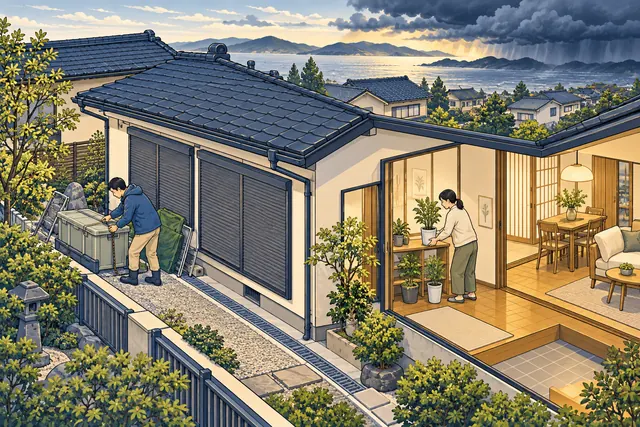
- 01
Check weather information and local evacuation guidance
- 02
From ground level, check abnormalities and items that may blow away
- 03
Keep contact details for your insurer, property manager and contractor
Useful photos to take before problems occur
Record each building side, roof views from the ground, gutters, windows, and previous repairs to explain later changes. Save dates and do not confuse these with photos of current damage.
Check safety before reading the article
If there is danger or you cannot judge, move to safety.
Do not photograph or operate equipment in unsafe areas. Call 119 for fire or rescue.
Record times and symptoms, then contact management or a repair service. This is not a finding that safety is guaranteed.
Do not take risks when you find something abnormal
For suspected detached gutters, lifted flashing, or shifted tiles, consult experts rather than approaching to fix them. Stop outdoor checks once strong winds or rain begin. Discuss arrangements if repairs cannot be completed in time.
Organize the agreement, not just the phone number
Collect policies, plans, work history, warranties and manager/maintenance contacts. Facilities should define after-hours decision-makers/authority, keys and alternative business locations.
Distinguish light rain from already severe weather
Typhoon preparations cannot be done equally safely at every time. JMA advises outdoor preparations before heavy rain or strong winds.
| Timing | Choose within safe limits | What we do not do |
|---|---|---|
| While the weather is calm | Lock windows, bring loose items inside, clear safely reachable drains, and check lights, drinking water and communications. | Climbing onto roofs or high places. Moving heavy equipment or things outside your authority yourself. |
| Wind or rain has intensified, or evacuation information was issued | Follow local guidance for safety. Prioritize relocation or evacuation over outdoor cleanup. | Repair gutters, continue outdoor checks, or go to rivers or the sea to look. |
| After it passes | Check danger from a distance; ask management or contractors about abnormalities. Record only from safe places. | Approaching broken power lines, wet electrical equipment, falling objects, or damaged areas. |
Adapt one preparation step for coastal, riverside or apartment living
Near coasts or estuaries, distinguish storm surge from tsunami; beside rivers or on low ground, check river and urban flooding information; near slopes, check landslide information. In apartments, keep shared evacuation routes and balcony escape equipment clear, and tidy according to management rules.
How to find official maps and local information using your address、Pre-disaster preparedness listcan also be checked. The area name alone determines neither risk nor repair need.
Additional materials:JMA: Preparing for disasters yourself、Hazard Map Portal(Checked on 26 October 2026.)
Frequently asked questions about this topic
Must I always call an inspector before a typhoon?
It is not universally necessary for every building. Consult based on faults, history, and maintenance plans. Do not decide immediately under an unexpected sales approach.
FAQ and related guidance checked October 4, 2026. Ask relevant contacts about individual conditions, current acceptance, and programs.
Content errors, rights concerns or service information changes:Contact Kaneyoshi Miwa (Japan Product Management). Include the page URL and relevant passage. This is for routine inquiries, not emergency reporting.
What to learn next
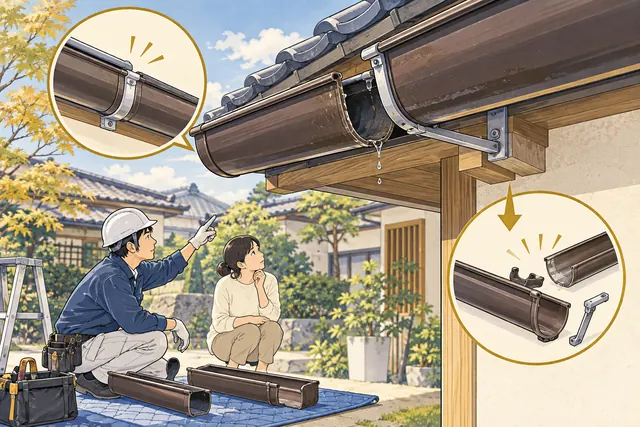
Detached gutters: who to hire and repair or replacement checks
Detached gutters, joint leaks, and overflow: contacts such as sheet-metal or roofing providers, and questions on repair versus replacement.
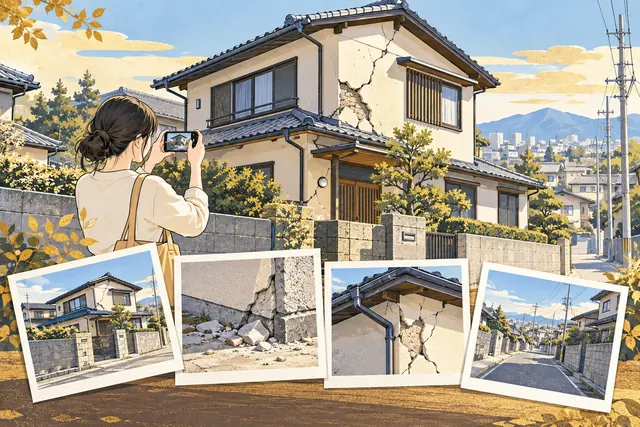
Pre-repair photos: building, location, close-ups, and wider views
Organize photos for provider consultations, damage records, and insurance checks. Avoid unsafe photography; show when, where, and what.
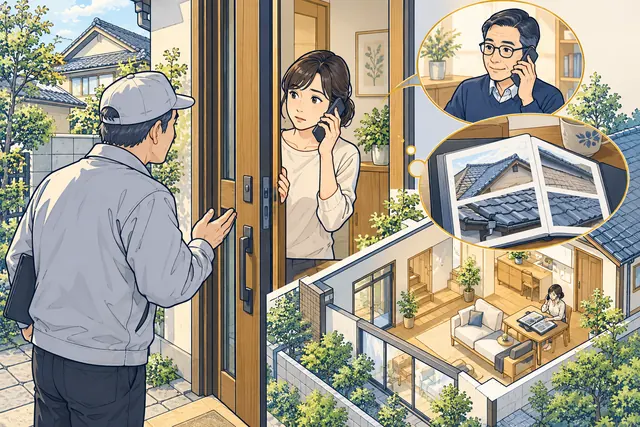
Do not panic over “unsafe roof” or “free with insurance”: handling inspection sales
Unexpected roof repair sales: checks and advice contacts before believing photos or insurance explanations.
Plan for lighting before the wind picks up

Things to know about housing in Japan
Rules differ by building and rental agreement. Ask your property manager or local municipality if you are unsure.
In a rented home, contact the manager before ordering repairs
Tell your property manager or landlord about the problem first. Before making your own contract, check who to contact, who pays and what work is covered.
Corridors and balconies may form part of an escape route
Keep shared corridors, balcony partitions (隔て板) and escape hatches (避難ハッチ) clear of belongings. Ask the property manager about your building's rules. Do not break partitions or open escape equipment for practice on your own.
An evacuation site and a shelter may serve different purposes
A designated emergency evacuation site (指定緊急避難場所) is a place to escape immediate disaster danger. A designated evacuation shelter (指定避難所) is a facility for staying after evacuation. Check the disaster type and your municipality's instructions.
Read current official disaster information in your language
JMA / English
Reference: Cabinet Office guidance on evacuation sites and shelters
Words used in this article
Short explanations, with the Japanese words you may hear in everyday life.
- Contact details 連絡先(renrakusaki)
Information such as a telephone number or office for getting in touch.
Keep details for your property manager, previous contractor and insurer beforehand; check their languages and opening hours.
- Property management company 管理会社(kanri gaisha)
A company appointed to manage a building and handle contact on the owner's behalf.
For a rented home or apartment building, check the contact details in your agreement or building notices.
- Rain gutter 雨樋(amadoi)
A channel or pipe that collects rainwater from the roof and carries it down.
If it is loose, stay on the ground and tell a professional what you can see.
- Sheet-metal work 板金(bankin)
Building parts made by shaping thin metal sheets, often used at roof edges and joints.
Ask which metal parts and locations the estimate covers.
- Warranty 保証(hoshou)
Conditions describing how certain problems after the work will be handled.
Check coverage, period, exclusions and contact details in writing; a warranty does not make every repair free.
- Storm surge 高潮(takashio)
Sea level rising above normal due to low air pressure and winds, including those from a typhoon.
It differs from a tsunami. Check current information from the Japan Meteorological Agency and local authorities.
- Tsunami 津波(tsunami)
Waves caused by events such as an undersea earthquake that travel toward and reach the coast.
Do not go to the coast to look. Follow evacuation information from official authorities.
- Multi-unit housing 集合住宅(shuugou juutaku)
A building containing homes for several households, such as an apartment building.
Distinguish your own unit from shared areas and check building rules for repairs and evacuation.
- Evacuation route 避難経路(hinan keiro)
The route for moving from a dangerous place to a safer place.
Check it with your household and keep passages and exits clear.
- Emergency escape equipment 避難器具(hinan kigu)
Equipment such as ladders installed to help people escape a building in an emergency.
Ask the manager about its location and use beforehand, keep it clear, and do not open or descend it alone just to practise.
- Local authority 自治体(jichitai / shikuchouson)
The administration of your city, ward, town, village or prefecture.
Use your area's official website or office to check evacuation sites and post-disaster procedures.
- Landlord 大家(ooya / kashinushi)
The person or company renting out a room or home.
Check whether repairs should be reported to the landlord or management company before arranging work yourself.
- Shared corridor 共用廊下(kyouyou rouka)
A passage used by multiple residents in a multi-unit building, sometimes also an escape route.
Check rules for belongings and bicycles and do not block passage or evacuation.
- Balcony partition panel 隔て板(hedateita / shikiri ita)
A panel between neighbouring balconies; some are designed as part of an emergency escape route.
Ask the manager whether it is for escape and how to use it; keep it clear and do not break it for practice.
- Emergency escape hatch 避難ハッチ(hinan hacchi)
A covered opening in a balcony floor or similar location used for escape to a lower floor.
Check building instructions with the manager, keep it clear, and do not open or descend it alone for practice.
- Designated emergency evacuation site 指定緊急避難場所(shitei kinkyuu hinan basho)
A place officially designated for escaping an immediate disaster danger.
Sites are designated by disaster type. Check suitability for the current hazard, not just distance.
- Evacuation shelter 避難所(hinanjo / shitei hinanjo)
A facility where people unable to return home after a disaster can stay temporarily.
Its purpose differs from an immediate escape site. Check which shelters are open with local authorities.
Plain-language explanations by Tatemono Fukkyu Note. They are not an assessment of your building or an individual evacuation decision.