
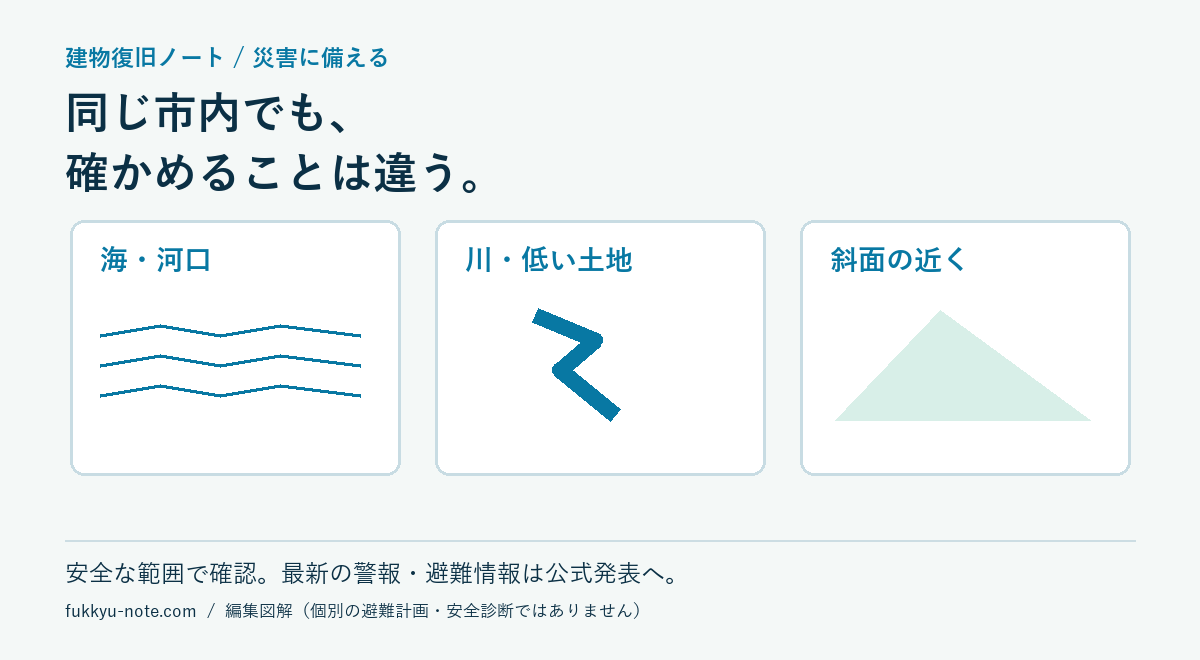
Plan using address, terrain, and building conditions, not prefecture alone. Check hazard-map scenarios and update day-of information using JMA and municipal publication times.
Set up disaster alerts and save your evacuation route
Before heavy rain, bookmark two official pages on your phone: the Japan Meteorological Agency (JMA) and your municipality. Keep your evacuation destination and route available offline.
- Save two official sources. Bookmark JMA alerts in English and your city, ward, town or village’s official evacuation page. To find the municipal page, search its Japanese name plus 防災 避難情報. The Safety tips app listed by the Japan Tourism Agency offers English notifications. If you use it, allow notifications on your phone and keep checking local government information.
- Find where you can go from home. Look up your address on Japan’s national hazard map portal. Check the hazard that matters, such as flooding or a landslide, and find a suitable evacuation site and a route. Use municipal updates to see which sites are open now. A map listing tells you where a site is.
- When an alert arrives, check the area and issue time. Look for your district or current location and check the latest notice from the municipality or JMA. Keep the municipality’s name, your destination and route in a paper or offline note. You can also download the government’s English disaster guide (PDF). If danger is immediate, get to safety without waiting for a translation or map to load.
Level 4 means different things in a weather warning and an evacuation instruction
Since May 29, 2026, JMA has used names such as レベル4大雨危険警報 for a Level 4 heavy rain warning. That warning flags areas where the hazard is growing. A municipal 警戒レベル4避難指示 is a Level 4 instruction to evacuate from dangerous locations. If you are in a dangerous location, evacuate by Level 4. If local risk is rising on JMA’s Kikikuru risk map or in other official information, evacuate while you can still move safely, even if a municipal instruction is still pending. Check separate earthquake and tsunami information for those hazards.
JMA’s new warning names (Japanese) · Government evacuation guidance and multilingual materials · Checked
For other languages, see the Japanese government’s multilingual disaster guides or read our 简体中文:日本防灾预警与避难 guide.
Open the map by address and switch disaster types
Hazard Map Portal lets you search by address for river and urban flooding, landslides, storm surge, tsunami, and other hazards. Uncolored areas are not automatically safe; check the legend, assumptions, and coverage. Also consult municipal maps and evacuation guidance.
- Find your home and the routes you normally use.
- Check river floods, urban flooding, landslides, storm surge, and tsunami separately.
- Check designated emergency evacuation locations and shelters. Availability depends on disaster type; do not choose by name alone.
- Check local evacuation information and JMA announcement times that day. Do not rely only on old posts.
Look at site conditions, beyond the area name, for the next check
| Examples by area and situation | What to verify first | Actions to avoid |
|---|---|---|
| Homes near coasts or river mouths, such as Akashi and Kobe | Home-specific storm surge, tsunami, and flood scenarios and city evacuation guidance; risks differ within a city. | Approaching waves or rivers to take photos. |
| Coastal homes after earthquake news, such as Aomori and Iwate | Check local tsunami evacuation places/routes and indoor falling objects. Verify home conditions separately from the reported epicenter. | After strong or prolonged shaking, finish checking the home before evacuating. |
| In any region: riversides, low ground and areas near slopes | Disaster-specific maps and Kikikuru: can you move before dark? | Go to inspect flooded roads or waterways. |
| Upper-floor apartments and detached-home bedrooms | Furniture and appliance placement and movement, exits, and the building's disaster plan. | Holding furniture during shaking. Placing personal belongings in shared escape routes. |
Place names illustrate how to check. They do not indicate current warnings/damage/evacuation orders here, or guarantee local availability or immediate arrangements.
Typhoon news shared on social media: is the date current?
An announcement from 23 October may still be shared as “approaching” on the 26th. Check the typhoon number, issue time, area and later updates. An older municipal notice can help with preparedness but does not replace current track or evacuation information.
Keep checking rain/wind after a typhoon becomes a low-pressure system. Its formation alone does not mean it is immediately approaching your area.What to do before wind and rain intensifyand stop outdoor work when there is danger.
Go directly to official information
- MLIT / Geospatial Information Authority: Hazard Map Portal
- Japan Meteorological Agency: latest typhoon information
- Japan Meteorological Agency: Kikikuru
- JMA: protecting yourself from earthquakes
Checked: October 26, 2026. No address or location data needs entering into Tatemono Fukkyu Note. Go to the official site to check yourself.
After preparing, if unsure whom to ask about building faults or repairs
Tatemono Fukkyu Note is an information site operated by Japan Product Management LLC. General disaster-preparedness information should be distinguished from diagnosis and work for a specific building. Local authorities, property managers, previous contractors and maintenance companies are also possible advice contacts.
Fukkyu Idaten operator: Japan Product Management LLC. Originator: Naniya Co., Ltd. This emergency preparedness and repair network connects learning about disaster readiness with preparing to seek repair advice after a disaster. The article does not guarantee that the app will make individual evacuation decisions, diagnose safety, arrange preliminary inspections, or arrange repairs.
If you check disaster information on your phone
Things to know about housing in Japan
Rules differ by building and rental agreement. Ask your property manager or local municipality if you are unsure.
In a rented home, contact the manager before ordering repairs
Tell your property manager or landlord about the problem first. Before making your own contract, check who to contact, who pays and what work is covered.
Corridors and balconies may form part of an escape route
Keep shared corridors, balcony partitions (隔て板) and escape hatches (避難ハッチ) clear of belongings. Ask the property manager about your building's rules. Do not break partitions or open escape equipment for practice on your own.
An evacuation site and a shelter may serve different purposes
A designated emergency evacuation site (指定緊急避難場所) is a place to escape immediate disaster danger. A designated evacuation shelter (指定避難所) is a facility for staying after evacuation. Check the disaster type and your municipality's instructions.
Read current official disaster information in your language
JMA / English
Reference: Cabinet Office guidance on evacuation sites and shelters
Words used in this article
Short explanations, with the Japanese words you may hear in everyday life.
- Storm surge 高潮(takashio)
Sea level rising above normal due to low air pressure and winds, including those from a typhoon.
It differs from a tsunami. Check current information from the Japan Meteorological Agency and local authorities.
- Tsunami 津波(tsunami)
Waves caused by events such as an undersea earthquake that travel toward and reach the coast.
Do not go to the coast to look. Follow evacuation information from official authorities.
- Multi-unit housing 集合住宅(shuugou juutaku)
A building containing homes for several households, such as an apartment building.
Distinguish your own unit from shared areas and check building rules for repairs and evacuation.
- Evacuation route 避難経路(hinan keiro)
The route for moving from a dangerous place to a safer place.
Check it with your household and keep passages and exits clear.
- Property management company 管理会社(kanri gaisha)
A company appointed to manage a building and handle contact on the owner's behalf.
For a rented home or apartment building, check the contact details in your agreement or building notices.
- Local authority 自治体(jichitai / shikuchouson)
The administration of your city, ward, town, village or prefecture.
Use your area's official website or office to check evacuation sites and post-disaster procedures.
- Landlord 大家(ooya / kashinushi)
The person or company renting out a room or home.
Check whether repairs should be reported to the landlord or management company before arranging work yourself.
- Shared corridor 共用廊下(kyouyou rouka)
A passage used by multiple residents in a multi-unit building, sometimes also an escape route.
Check rules for belongings and bicycles and do not block passage or evacuation.
- Balcony partition panel 隔て板(hedateita / shikiri ita)
A panel between neighbouring balconies; some are designed as part of an emergency escape route.
Ask the manager whether it is for escape and how to use it; keep it clear and do not break it for practice.
- Emergency escape hatch 避難ハッチ(hinan hacchi)
A covered opening in a balcony floor or similar location used for escape to a lower floor.
Check building instructions with the manager, keep it clear, and do not open or descend it alone for practice.
- Emergency escape equipment 避難器具(hinan kigu)
Equipment such as ladders installed to help people escape a building in an emergency.
Ask the manager about its location and use beforehand, keep it clear, and do not open or descend it alone just to practise.
- Designated emergency evacuation site 指定緊急避難場所(shitei kinkyuu hinan basho)
A place officially designated for escaping an immediate disaster danger.
Sites are designated by disaster type. Check suitability for the current hazard, not just distance.
- Evacuation shelter 避難所(hinanjo / shitei hinanjo)
A facility where people unable to return home after a disaster can stay temporarily.
Its purpose differs from an immediate escape site. Check which shelters are open with local authorities.
Plain-language explanations by Tatemono Fukkyu Note. They are not an assessment of your building or an individual evacuation decision.