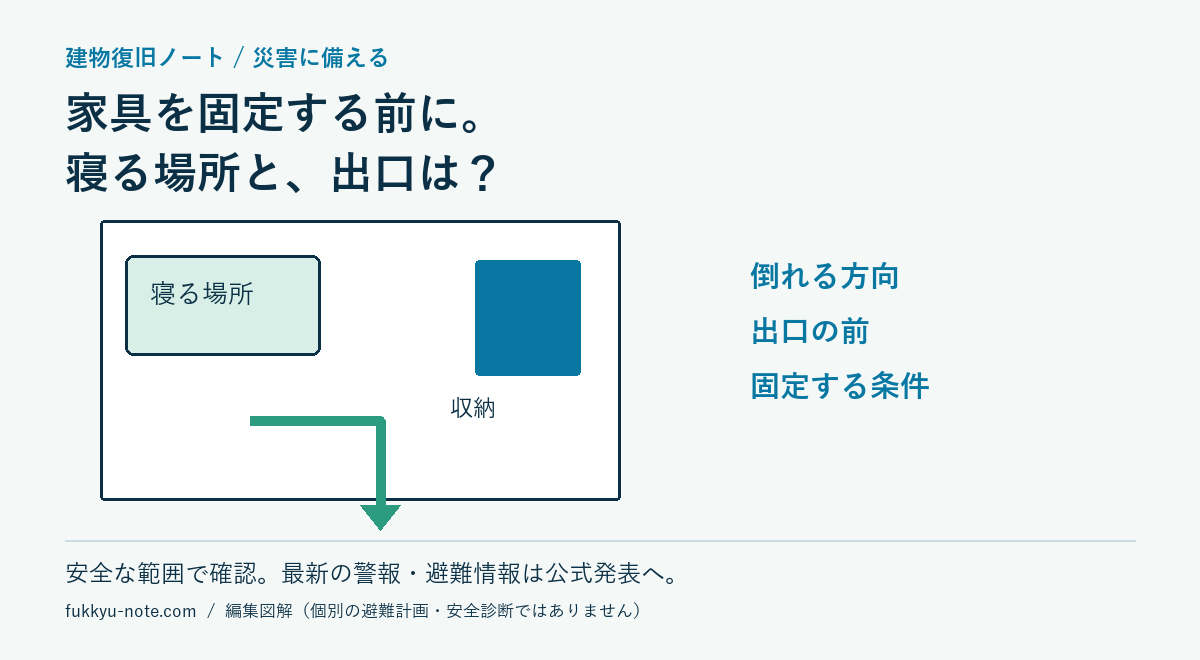
Before adding disaster supplies, review sleeping areas, exits, and furniture placement. Choose fixings suited to the walls and furniture; ask management, your builder, or a specialist if backing or installation methods are unclear.
From your sleeping spot, what could fall or topple?
During nighttime shaking, you may not be able to immediately move or support large furniture. In ordinary times, check with your family for tall storage or heavy objects near bedding and exits in furniture’s fall path.
You need not move heavy furniture alone or drill where wall backing and wiring are unknown during this check. First note the layout and problem spots, then confirm methods before taking action.
“Can we reach the entrance?” Consider item placement
Keep entrances and corridors free of items that could topple or move and block the way. Check drawers that slide out and appliances on top of furniture too. Tokyo disaster information and the Fire and Disaster Management Agency identify furniture placement in relation to exits as one preparedness measure.
| Where to look | What to verify | What not to decide on your own |
|---|---|---|
| Bedroom | Furniture that could fall onto bedding, and heavy items overhead. | Moving large furniture and fastening it to walls. |
| Entrance and hallway | Storage units or belongings that could fall and block a door or passage. | Placing personal belongings or protective devices in shared areas. |
| Kitchen or work room | Movement of appliances, stored items and furniture on casters. | Fastening that damages equipment, or placement obstructing wiring or heat sources. |
Rentals or apartments: what to ask before buying fixings?
Ask the property manager or contractor whether fixing to this wall is possible, which underlying support should be used, and what restoration or shared-area rules apply. A fixing device alone does not guarantee safety: consider its instructions together with the furniture and wall conditions. On upper floors, furniture may move as well as topple, so also check the building's disaster plan and evacuation routes.
When shaking starts, protect yourself before tidying up or taking photos
During shaking, protect your head and keep clear of falling or toppling objects. Do not force your way to a flame or try to support large furniture. On the coast, strong shaking or even weak but prolonged shaking calls for tsunami evacuation first; do not inspect the house beforehand.
After shaking stops, avoid areas showing damage or falling hazards. Photos alone cannot establish building safety.Separate discussions to have after an earthquakeYou can check this too.
Official sources consulted
- Tokyo Metropolitan Government: preventing furniture tipping, falling and moving
- Fire and Disaster Management Agency: furniture, sleeping positions and exits
- JMA: when you receive an Earthquake Early Warning
Checked: October 26, 2026. This article does not predict earthquake dates or magnitudes. Ask experts about specific fixing methods, work, and building conditions.
After preparing, if unsure whom to ask about building faults or repairs
Tatemono Fukkyu Note is an information site operated by Japan Product Management LLC. General disaster-preparedness information should be distinguished from diagnosis and work for a specific building. Local authorities, property managers, previous contractors and maintenance companies are also possible advice contacts.
Fukkyu Idaten operator: Japan Product Management LLC. Originator: Naniya Co., Ltd. This emergency preparedness and repair network connects learning about disaster readiness with preparing to seek repair advice after a disaster. The article does not guarantee that the app will make individual evacuation decisions, diagnose safety, arrange preliminary inspections, or arrange repairs.
One more step to prepare a place to sleep
Things to know about housing in Japan
Rules differ by building and rental agreement. Ask your property manager or local municipality if you are unsure.
In a rented home, contact the manager before ordering repairs
Tell your property manager or landlord about the problem first. Before making your own contract, check who to contact, who pays and what work is covered.
Corridors and balconies may form part of an escape route
Keep shared corridors, balcony partitions (隔て板) and escape hatches (避難ハッチ) clear of belongings. Ask the property manager about your building's rules. Do not break partitions or open escape equipment for practice on your own.
An evacuation site and a shelter may serve different purposes
A designated emergency evacuation site (指定緊急避難場所) is a place to escape immediate disaster danger. A designated evacuation shelter (指定避難所) is a facility for staying after evacuation. Check the disaster type and your municipality's instructions.
Read current official disaster information in your language
JMA / English
Reference: Cabinet Office guidance on evacuation sites and shelters
Words used in this article
Short explanations, with the Japanese words you may hear in everyday life.
- Shared building areas 共用部分(kyouyou bubun)
Parts of an apartment building used by more than one resident, such as corridors and stairs.
Check with the property manager before making changes or arranging work yourself.
- Property management company 管理会社(kanri gaisha)
A company appointed to manage a building and handle contact on the owner's behalf.
For a rented home or apartment building, check the contact details in your agreement or building notices.
- Restoration 復旧(fukkyuu)
Work to make something usable again after a disaster or other damage.
Check the necessary order with professionals, including safety checks, finding the cause and repairs.
- Evacuation route 避難経路(hinan keiro)
The route for moving from a dangerous place to a safer place.
Check it with your household and keep passages and exits clear.
- Tsunami 津波(tsunami)
Waves caused by events such as an undersea earthquake that travel toward and reach the coast.
Do not go to the coast to look. Follow evacuation information from official authorities.
- Local authority 自治体(jichitai / shikuchouson)
The administration of your city, ward, town, village or prefecture.
Use your area's official website or office to check evacuation sites and post-disaster procedures.
- Landlord 大家(ooya / kashinushi)
The person or company renting out a room or home.
Check whether repairs should be reported to the landlord or management company before arranging work yourself.
- Shared corridor 共用廊下(kyouyou rouka)
A passage used by multiple residents in a multi-unit building, sometimes also an escape route.
Check rules for belongings and bicycles and do not block passage or evacuation.
- Balcony partition panel 隔て板(hedateita / shikiri ita)
A panel between neighbouring balconies; some are designed as part of an emergency escape route.
Ask the manager whether it is for escape and how to use it; keep it clear and do not break it for practice.
- Emergency escape hatch 避難ハッチ(hinan hacchi)
A covered opening in a balcony floor or similar location used for escape to a lower floor.
Check building instructions with the manager, keep it clear, and do not open or descend it alone for practice.
- Emergency escape equipment 避難器具(hinan kigu)
Equipment such as ladders installed to help people escape a building in an emergency.
Ask the manager about its location and use beforehand, keep it clear, and do not open or descend it alone just to practise.
- Designated emergency evacuation site 指定緊急避難場所(shitei kinkyuu hinan basho)
A place officially designated for escaping an immediate disaster danger.
Sites are designated by disaster type. Check suitability for the current hazard, not just distance.
- Evacuation shelter 避難所(hinanjo / shitei hinanjo)
A facility where people unable to return home after a disaster can stay temporarily.
Its purpose differs from an immediate escape site. Check which shelters are open with local authorities.
Plain-language explanations by Tatemono Fukkyu Note. They are not an assessment of your building or an individual evacuation decision.