
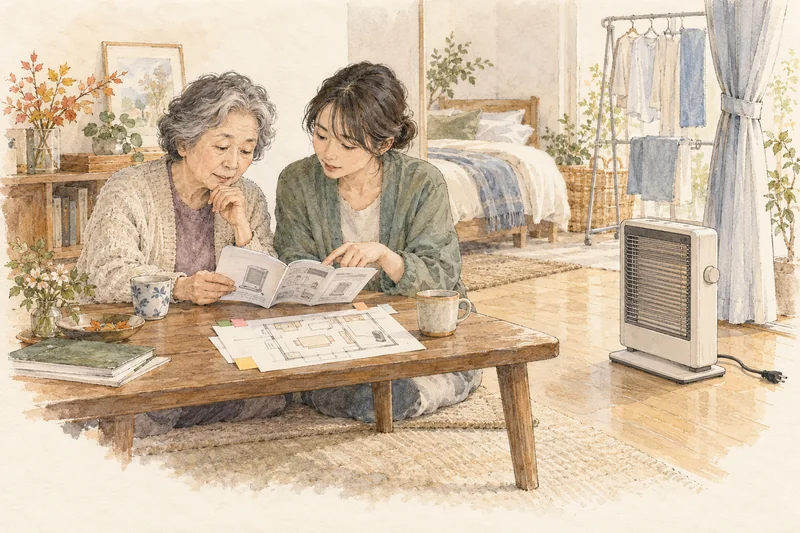
What would you check in your room?
Select an item to highlight what to check. The rearrangement shows an appliance switched off and fully cooled.
Could laundry fall from above?
Do not dry laundry above or near a heater. Consider falling or moving items and check the required distances in your model’s manual.
The changed illustration is not a safety verdict. Check the front, back, sides and space above for your actual appliance and room.
Keep unknowns in your family notes →35 seconds: before switching on a heater
Follow the checks in moving diagrams: falling laundry, the directions to check in the manual, and a damaged cord.
The main explanation has no narration. Screens are in Japanese, with Japanese, English and Vietnamese captions. You can watch without sound.
- Check placement
- Read your model’s manual
- Stop and ask if abnormal
- Switch off before sleep or leaving
Read the video as text
Start with three checks: location, the heater and cord, and its instructions. Keep laundry and bedding away; use your model's manual to find the required clearances. If anything is damaged or deformed, do not test it by switching it on—ask the manufacturer or retailer. Switch it off or extinguish it before sleeping or going out.
Three checks before use
1. Location. Combustible materials are things that can burn, including clothes and bedding. Do not dry laundry above the heater or leave bedding, clothes or curtains nearby. Consider items falling or moving into contact. Required clearance means the space required between a hot appliance and surrounding objects. Required space above, in front and at the sides varies by model; one distance is not a rule for every heater.
2. Heater and cord. Stop operation, let the appliance cool, and follow its manual before inspecting or cleaning. For electric models, unplug as directed. Look for visible damage, deformation and dust, and check that furniture is not pressing on the cord. Do not repair a damaged cord with tape or take the appliance apart.
3. Instructions and use. Find the model number and check the manufacturer's manual and recall information. A recall is a notice about action such as returning or repairing an affected product. If the model or instructions are unclear, ask the manufacturer or retailer before use. Do not guess the clearance, fuel or ventilation requirements.
By heater type: check, stop, ask
| Heater type | What to check before use | When to stop and who to ask |
|---|---|---|
| All types | Laundry, bedding and curtains; the clearances above, in front and at the sides in your model's manual. | If clearance or use is unclear, ask the manufacturer or retailer before use. Switch off before sleeping or leaving. |
| Electric radiant or fan heater | Damage or deformation to the cord, plug or body; dust; connection and power limits; recalls. | Stop if damaged or abnormal. Do not tape-repair or dismantle; ask the manufacturer or retailer. |
| Kerosene heater | The specified fresh kerosene, tank cap and leaks, dust on the base, and ventilation instructions. | Do not use old kerosene or gasoline. Extinguish and follow cooling instructions before refuelling. Ask the manufacturer if unsure. |
| Gas heater that releases exhaust indoors | Correct gas type, connection condition, required clearances and ventilation in the manual. | Do not use without ventilation. Do not improvise connection repairs; contact the gas supplier or manufacturer. |
Different heaters need different checks
Electric heaters can become hot enough to ignite objects that touch them. Daisy-chained power strips and overloaded multi-outlet connections can also overheat. Check the heater's power requirements and connection instructions; do not exceed the permitted capacity.
Kerosene heaters need the fresh kerosene specified for the appliance—not fuel left from last season or gasoline. Extinguish the heater and follow its cooling instructions before refuelling. Kerosene and gas heaters that release combustion gases into the room use indoor air and need ventilation. Follow the model's ventilation instructions; do not use them where ventilation is unavailable.
Six checks to share with your household
Choose Not checked, Checked or Not applicable for your own notes. This is not a score, pass certificate or safety assessment. Marking Checked does not guarantee safety. Leave unclear items as Not checked and ask the appropriate contact.
Selections stay on this page. They are not sent to a server or analytics and are not saved automatically. You can keep unchecked items in the notes.
Consider falling or moving objects too. Do not move a hot heater to check.
Check each direction specified. If unclear, leave Not checked and ask the manufacturer.
Do not use if damaged or deformed. Ask for advice; do not dismantle or repair it yourself.
For kerosene models, use the specified fresh kerosene. Select Not applicable for electric-only heaters.
Kerosene and gas heaters that release exhaust indoors need room ventilation. Follow the model's manual.
Keep the route clear. Do not climb unsafely to test alarms; ask the property manager if needed.
Keep unchecked items to decide what to ask next.
A checked-item count is not a safety score. Follow the actual condition, manual and manufacturer’s advice.
If something seems wrong, do not switch it on to test
Stop use and contact the manufacturer or retailer if you find damage, deformation, unusual sounds or smells, or abnormal heat. Do not restart it to take a photo. If there are flames or smoke and a fire may be developing, move to safety and call 119 in Japan. Reaching safety takes priority over reading this guide or contacting our company.
As part of everyday preparation, agree to switch off or extinguish heaters before sleeping or going out. Keep escape routes clear and check how to test your home's fire alarms. Do not reach dangerously high to touch equipment; ask the property manager about equipment in rental or shared buildings.
Choose the right contact for the situation
Flames or smoke; possible fire
Move to safety and call 119 in Japan. Our company is not an emergency service.
Damage, unusual sounds, or an unclear model or manual
Stop use and ask the manufacturer or retailer. Ask the gas supplier about gas compatibility and connections.
Questions about equipment or escape routes in rental/shared housing
Ask the property manager or landlord. Do not remove high or fixed equipment yourself.
After reaching safety, unsure about building damage or repair contacts
Explain the situation to your existing contractor or property manager. Our consultation memo can help organize facts and unanswered questions.
After preparing, organize any housing questions
Wet electrical equipment requires different handling from routine checks. See the guide on wet electrical equipment. If you are unsure whether repairs are needed or whom to contact, first get to safety, then use the consultation note to record the situation and open questions. Fukkyu Idaten operator: Japan Product Management LLC. Originator: Naniya Co., Ltd. This does not make evacuation decisions, inspect products or make emergency calls for you.
Related reading and consultation preparation
Tatemono Fukkyu Note is operated by Japan Product Management LLC. Contact the manufacturer or another suitable party for product inspection or repair. If you are unsure about home repairs, you can read the Fukkyu Idaten guide once you are safe.
Sources and dates
NITE published its notice on 29 October 2026. We published this guide and checked the sources on 31 October. Check the latest manufacturer information for your appliance too.
- NITE: heater clearances and pre-use checks
- Tokyo consumer information: seasonal appliance checks and stopping abnormal equipment
- Toho Gas: ventilation and use of gas fan heaters and stoves
- National Research Institute of Fire and Disaster: heater use and safe clearances
- Tokyo Fire Department: home fire prevention and alarms
- Fire and Disaster Management Agency: 119 emergency calls
Words used in this article
Short explanations, with the Japanese words you may hear in everyday life.
- Combustible material 可燃物(kanenbutsu)
Something that can burn, such as laundry, bedding, clothes or curtains.
Objects can be too close even without touching the heater. Follow its clearance instructions and never dry laundry above it.
- Required clearance 離隔距離(rikaku kyori)
The space that must be left between a heater and walls or objects that can burn.
Check the product label or manual for the required space in front, behind, beside and above it.
- Product recall リコール(rikoru)
Action by a business, such as collecting, repairing or replacing a product, to address a safety problem.
Match the maker and model with official recall information. Stop using a recalled product and contact the listed service.
- Kerosene 灯油(toyu)
Fuel used by compatible kerosene heaters. It is different from gasoline or petrol.
Use fresh kerosene specified for the heater, not fuel left over from last season. Store it separately from gasoline to prevent mix-ups.
- Daisy-chained power strips たこ足配線(takoashi haisen)
Connecting power strips or adaptors together to add more sockets to one outlet.
Do not connect power strips in series. Observe the marked electrical limit; even a few appliances can exceed it.
- Unflued fuel-burning heater 開放型暖房器具(kaihogata danbo kigu)
A heater that burns fuel using room air and releases combustion gases into the room.
Ventilate with fresh outdoor air as its manual instructs. A fan that only moves indoor air does not replace that air.
- Property management company 管理会社(kanri gaisha)
A company appointed to manage a building and handle contact on the owner's behalf.
For a rented home or apartment building, check the contact details in your agreement or building notices.
- Evacuation route 避難経路(hinan keiro)
The route for moving from a dangerous place to a safer place.
Check it with your household and keep passages and exits clear.
- Home fire alarm 住宅用火災警報器(jutakuyo kasai keihoki)
A device that detects smoke or heat and alerts people at home. It does not put out a fire.
Test it and check its replacement date as the manual instructs. Ask the property manager or another suitable person for help with high places.
- Landlord 大家(ooya / kashinushi)
The person or company renting out a room or home.
Check whether repairs should be reported to the landlord or management company before arranging work yourself.
Plain-language explanations by Tatemono Fukkyu Note. They are not an assessment of your building or an individual evacuation decision.