
There is no single standard price. Separate the investigation, emergency measures, and repairs or interior restoration, then check what each fee includes. Before commissioning work, ask whether you will be charged if you stop after the investigation or the cause cannot be identified.
Understand this article's terms in plain language
- Temporary measures
- Temporary measures to limit further damage. Check these separately from permanent repairs and fixing the cause.
- Cause investigation
- Investigation of water-entry routes and similar issues. Ask methods, cost, and uncheckable areas.
- Scaffolding and protection
- Scaffolding supports work at height; protection shields surrounding items and areas. Check quote scope.
Is leak investigation charged separately from repair? Pre-request checklist
Before assuming an inspection will fix it, establish whether this requestCause investigation only, or repairs too?separately. An investigation quote alone may not include scaffolding, permanent repair or interiors. Before price comparisons, check equal work and reporting scope.
1. Investigation agreement
Check locations, methods, access, reports/photos and billing terms if the job ends with investigation only.
2. When the cause is unknown
Have reports state what was checked and what remains unknown. If observation/reinspection is needed, ask methods, costs and approval timing beforehand.
3. When requesting repairs
Confirm in writing whether there is another quote, inspection fees are credited to repairs, and scaffolding or interiors are included. Do not assume a credit applies.
Ready-to-use questions for a quote request
- Is this inspection only, or does it include temporary or permanent repairs?
- Is the fee unchanged if no cause is found? What are reinspection terms?
- Are scaffolding, protection, waste disposal, interior restoration and tax all included?
- If scope expands, will you explain reasons and extra charges before approval?
- What will confirm completion, and how will conditions during the next rain be checked?
A water-spray test is one professional method of investigating a cause. The method's name alone does not guarantee necessity or successful identification. Do not climb onto the roof or spray walls to reproduce the leak yourself; discuss a method suited to the building.
Check warranty and recurrence conditions · Reading quotes that include scaffolding · Prepare for discussion when the cause is unknown
Basic information:Sumairu Dial: when you notice a rain leak. The editors organized the questions above; they do not guarantee work necessity, price, or findings. Checked October 20, 2026.
- 01
Align the estimate's locations with inspection findings
- 02
Check separate fees, quantities and unit prices
- 03
Ask before signing when extra work may be needed
Main reasons the total may change
Prices vary with difficulty locating water entry, roofing and waterproofing type, underlying damage, building height, vehicle access, scaffolding needs and whether interior restoration is included. Repairs to a small gap cannot be compared with whole-roof work at the same market price.
Align quote contents before comparing totals
Example comparison. Check actual company quotes using the same items.
Ask about missing items before comparing costs and timing.
Break the estimate into seven parts
① Travel and site inspection ② Additional tests such as water testing ③ Temporary measures ④ Scaffolding and protection ⑤ Materials and work ⑥ Removal, disposal, and interior restoration ⑦ Overheads and tax. Listing included, excluded, and undecided items helps comparison. For paid inspections, confirm the price and deliverables before booking.
Compare rain leak repair quotes using matching categories
Enter confirmed itemized amounts from your estimate in tax-inclusive yen. Leave items without amounts blank; enter zero only where you have confirmed no charge. Do not double-count a lump-sum total and the amounts already included within it.
This table does not judge price fairness or work necessity. Align locations, materials, quantities, warranties and schedules too.
On narrow screens, scroll the table sideways to see quotes A and B. With a keyboard, focus the table and use left and right arrows.
| Cost item | Quote A (yen) | Estimate B (yen) |
|---|---|---|
| Call-out and on-site inspection | ||
| Additional tests such as water spraying | ||
| Temporary measures | ||
| Scaffolding and protection | ||
| Materials and work | ||
| Removal, disposal and interior restoration | ||
| Other overhead costs |
Quote A: no amount entered.
Estimate B: amounts have not been entered.
This totals entered amounts. With blanks, it is not the full payment. Check separate fees, extras, cancellation charges and the quote's tax-inclusive total.
Entries stay on this page and are not saved or sent. Check copied notes yourself before sharing with an advice contact.
Unsure about costs or providers? Start with what you know
The operator can help organize questions about inspection and travel fees, included work, and conditions for additions.
Call Miwa: 070-1503-2646 Hours: 9:00–22:00
Phone consultation information / Prepare a note before contacting someone
For public quote adviceCenter for Housing Renovation and Dispute Settlement Support’s homepage explains eligibility for “Have a renovation quote checked.” Public advice and finding repair providers serve different roles.
What to check in an estimate that looks cheap
Scaffolding or disposal may cost extra, and interior restoration may be excluded. Conversely, a higher estimate may include work on recurring causes and underlying supports. Ask what this work will and will not fix, and why the scope differs.
Plan how to explain your budget before looking at price estimates
State your priorities: stop further damage now, reduce recurrence long term, or be consulted before exceeding a budget limit. Rather than discounts that omit safety or necessary work, check whether temporary measures and full repairs can be scheduled separately.
Why this page does not give one standard market price
We avoid presenting amounts with unverified areas, buildings, or work scope as though they were quotes for your property. An advertised “from ¥…” is not the total. Consumers concerned about a pre-contract quote may also use Sumairu Dial’s quote consultation service.
Frequently asked questions about this topic
Are estimates always free?
It is not necessarily free. Ask about travel, investigation, reports and cancellation fees before requesting.
How can I avoid unexpected costs?
Specify uncertainties such as hidden backing, and agree photos, prices, and approval before additions. This does not guarantee no extras.
FAQ and related guidance checked October 4, 2026. Ask relevant contacts about individual conditions, current acceptance, and programs.
Content errors, rights concerns or service information changes:Contact Kaneyoshi Miwa (Japan Product Management). Include the page URL and relevant passage. This is for routine inquiries, not emergency reporting.
What to learn next
Roof-repair quotes: eight comparison items beyond price
A practical checklist for comparing equivalent quotes: inspections, scaffolding, repair scope, dates, warranty and extras.
Extra repair costs: five checks before approval
If told extra substrate repairs are needed, check photos, reasons, price, duration, and alternatives.
Do small roof or gutter repairs need scaffolding? Quote questions
When scaffolding seems costly, check height, scope, site conditions, and combining work.
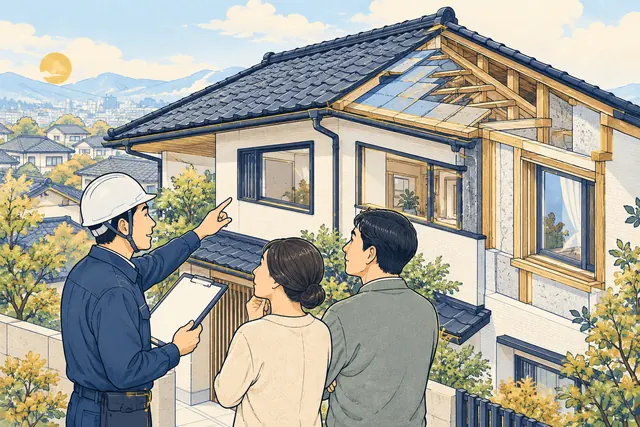
Finding rain leak repairers: check investigations, costs and availability
Organize leak photos and notes, compare methods, temporary measures, scope and dates, then consult Tatemono Fukkyu Note's operator.
Things to know about housing in Japan
Rules differ by building and rental agreement. Ask your property manager or local municipality if you are unsure.
In a rented home, contact the manager before ordering repairs
Tell your property manager or landlord about the problem first. Before making your own contract, check who to contact, who pays and what work is covered.
Corridors and balconies may form part of an escape route
Keep shared corridors, balcony partitions (隔て板) and escape hatches (避難ハッチ) clear of belongings. Ask the property manager about your building's rules. Do not break partitions or open escape equipment for practice on your own.
An evacuation site and a shelter may serve different purposes
A designated emergency evacuation site (指定緊急避難場所) is a place to escape immediate disaster danger. A designated evacuation shelter (指定避難所) is a facility for staying after evacuation. Check the disaster type and your municipality's instructions.
Read current official disaster information in your language
JMA / English
Reference: Cabinet Office guidance on evacuation sites and shelters
Words used in this article
Short explanations, with the Japanese words you may hear in everyday life.
- Restoration 復旧(fukkyuu)
Work to make something usable again after a disaster or other damage.
Check the necessary order with professionals, including safety checks, finding the cause and repairs.
- Scaffolding 足場(ashiba)
A structure assembled so workers can carry out work safely at height.
Whether it is needed depends on the height and work location. Do not climb it yourself.
- Additional charges 追加費用(tsuika hiyou / tsuika ryoukin)
Costs added later to the amount first proposed.
Confirm the extra work, reason and amount in writing before that work starts.
- Waterproofing 防水(bousui)
Materials or work that help keep water out of a building.
The right repair depends on the damage and its cause.
- On-site inspection 現地調査(genchi chousa)
A professional visiting the building to examine its condition and possible work.
Ask in advance about visit charges, what will be checked and how you will receive the findings.
- Warranty 保証(hoshou)
Conditions describing how certain problems after the work will be handled.
Check coverage, period, exclusions and contact details in writing; a warranty does not make every repair free.
- Recurrence 再発(saihatsu)
A problem happening again after it appeared to have stopped.
Record when it happens and the weather, then check the previous work and warranty when asking for advice.
- Property management company 管理会社(kanri gaisha)
A company appointed to manage a building and handle contact on the owner's behalf.
For a rented home or apartment building, check the contact details in your agreement or building notices.
- Local authority 自治体(jichitai / shikuchouson)
The administration of your city, ward, town, village or prefecture.
Use your area's official website or office to check evacuation sites and post-disaster procedures.
- Landlord 大家(ooya / kashinushi)
The person or company renting out a room or home.
Check whether repairs should be reported to the landlord or management company before arranging work yourself.
- Shared corridor 共用廊下(kyouyou rouka)
A passage used by multiple residents in a multi-unit building, sometimes also an escape route.
Check rules for belongings and bicycles and do not block passage or evacuation.
- Balcony partition panel 隔て板(hedateita / shikiri ita)
A panel between neighbouring balconies; some are designed as part of an emergency escape route.
Ask the manager whether it is for escape and how to use it; keep it clear and do not break it for practice.
- Emergency escape hatch 避難ハッチ(hinan hacchi)
A covered opening in a balcony floor or similar location used for escape to a lower floor.
Check building instructions with the manager, keep it clear, and do not open or descend it alone for practice.
- Emergency escape equipment 避難器具(hinan kigu)
Equipment such as ladders installed to help people escape a building in an emergency.
Ask the manager about its location and use beforehand, keep it clear, and do not open or descend it alone just to practise.
- Designated emergency evacuation site 指定緊急避難場所(shitei kinkyuu hinan basho)
A place officially designated for escaping an immediate disaster danger.
Sites are designated by disaster type. Check suitability for the current hazard, not just distance.
- Evacuation shelter 避難所(hinanjo / shitei hinanjo)
A facility where people unable to return home after a disaster can stay temporarily.
Its purpose differs from an immediate escape site. Check which shelters are open with local authorities.
Plain-language explanations by Tatemono Fukkyu Note. They are not an assessment of your building or an individual evacuation decision.