
Useful lessons from US EPA flood recovery guidance are safety checks and prompt cleaning and drying. Assess Japanese underfloors, tatami, and walls on site; do not copy overseas demolition or chemical prescriptions directly.
Understand this article's terms in plain language
- Cleaning and disinfection
- Dirt removal and disinfection are separate. Check official or specialist guidance for post-flood need and methods.
- Check drying inside
- Check necessary areas beyond floor or wall surfaces. Ask conditions for restoring finishes.
- Inspection scope
- Which places and methods the investigation covers. Ask about inaccessible areas and fees beforehand.
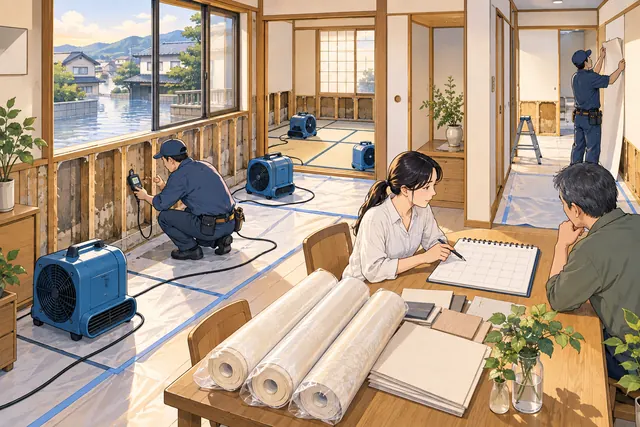
- 01
Check Japanese safety and hygiene information first
- 02
Arrange cleaning and drying providers early
- 03
Obtain check records before the area is closed up
A helpful order
Useful lessons include sequencing safe return, wet-item handling and reducing dirt/moisture. Arranging help early differs from rushing into danger.
From the current situation to the next request
These steps are general guidance organized by the editors.
- 01Check Japanese safety and hygiene information first
Do not inspect or take photos in dangerous places.
- 02Arrange cleaning and drying providers early
Separate known facts from what remains unknown.
- 03Obtain check records before the area is closed up
Agree on the person responsible, cost, timing and way to check.
What differs in Japanese homes
Work varies with tatami, underfloors, insulation, timber, and walls. Use photos and site checks, not demolition scopes based on US basements or materials.
Do not treat a time estimate as a guarantee
Early drying guidance does not guarantee every house becomes safe within a fixed time. Check material, weather, ventilation and equipment differences and how dryness is verified.
Four items to put in the contract
Align cleaning and removal targets, drying checks, and conditions for restoring interiors. Do not copy chemical concentrations or mixing from overseas; prioritize Japanese health-ministry and municipal guidance.
Frequently asked questions about this topic
Can overseas early-drying timelines become restoration deadlines in Japan?
Do not treat it as a fixed deadline. Flood extent, climate, underfloor and wall structure, and equipment differ. Use the principle of prompt appropriate action, and base finishing decisions on site checks.
Can fans alone dry inside walls and floors?
Surfaces cannot reveal hidden conditions. Ask cleaning, opening or removal needs, and where and how drying is checked. Do not independently copy overseas house structures or equipment layouts.
FAQ and related guidance checked October 4, 2026. Ask relevant contacts about individual conditions, current acceptance, and programs.
Content errors, rights concerns or service information changes:Contact Kaneyoshi Miwa (Japan Product Management). Include the page URL and relevant passage. This is for routine inquiries, not emergency reporting.
What to learn next
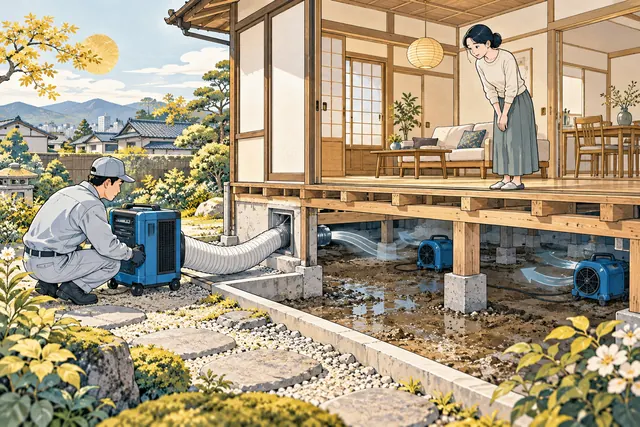
Crawl space flooding: cleaning, drying and checks after water recedes
Even if floors are not wet, mud, insulation, and equipment below may be affected. Do not crawl underneath yourself; arrange records and building and equipment checks.
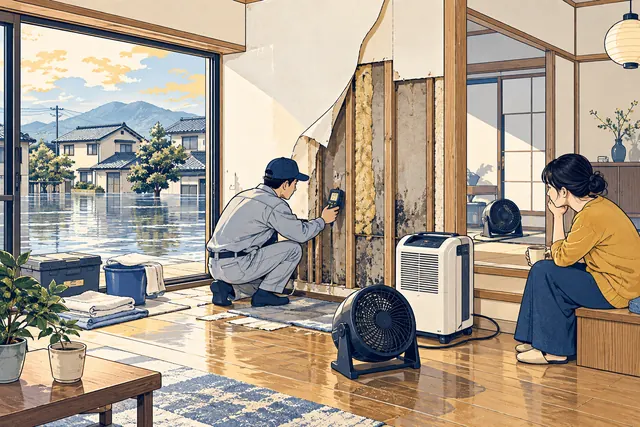
Musty after flooding: advice before replacing wallpaper
Before masking odors, investigate remaining moisture and contamination. Discuss causes, drying, removal, and rework separately; appearance alone does not establish completion.
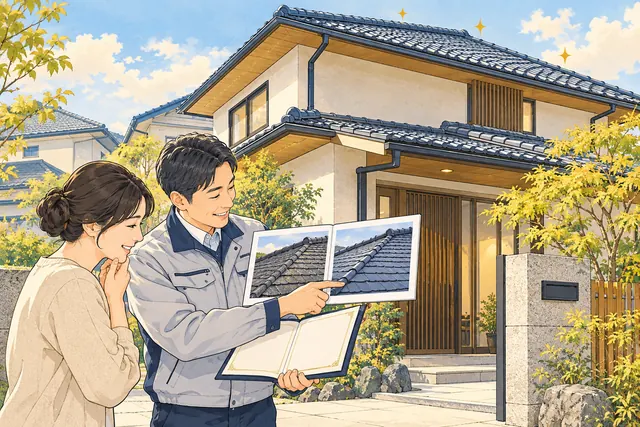
After repairs: completion, warranty, and recurrence records
Roof and leak-repair completion checks: keep photos and documents without climbing onto the roof.
Things to know about housing in Japan
Rules differ by building and rental agreement. Ask your property manager or local municipality if you are unsure.
In a rented home, contact the manager before ordering repairs
Tell your property manager or landlord about the problem first. Before making your own contract, check who to contact, who pays and what work is covered.
Corridors and balconies may form part of an escape route
Keep shared corridors, balcony partitions (隔て板) and escape hatches (避難ハッチ) clear of belongings. Ask the property manager about your building's rules. Do not break partitions or open escape equipment for practice on your own.
An evacuation site and a shelter may serve different purposes
A designated emergency evacuation site (指定緊急避難場所) is a place to escape immediate disaster danger. A designated evacuation shelter (指定避難所) is a facility for staying after evacuation. Check the disaster type and your municipality's instructions.
Read current official disaster information in your language
JMA / English
Reference: Cabinet Office guidance on evacuation sites and shelters
Words used in this article
Short explanations, with the Japanese words you may hear in everyday life.
- Restoration 復旧(fukkyuu)
Work to make something usable again after a disaster or other damage.
Check the necessary order with professionals, including safety checks, finding the cause and repairs.
- Property management company 管理会社(kanri gaisha)
A company appointed to manage a building and handle contact on the owner's behalf.
For a rented home or apartment building, check the contact details in your agreement or building notices.
- Local authority 自治体(jichitai / shikuchouson)
The administration of your city, ward, town, village or prefecture.
Use your area's official website or office to check evacuation sites and post-disaster procedures.
- Landlord 大家(ooya / kashinushi)
The person or company renting out a room or home.
Check whether repairs should be reported to the landlord or management company before arranging work yourself.
- Shared corridor 共用廊下(kyouyou rouka)
A passage used by multiple residents in a multi-unit building, sometimes also an escape route.
Check rules for belongings and bicycles and do not block passage or evacuation.
- Balcony partition panel 隔て板(hedateita / shikiri ita)
A panel between neighbouring balconies; some are designed as part of an emergency escape route.
Ask the manager whether it is for escape and how to use it; keep it clear and do not break it for practice.
- Emergency escape hatch 避難ハッチ(hinan hacchi)
A covered opening in a balcony floor or similar location used for escape to a lower floor.
Check building instructions with the manager, keep it clear, and do not open or descend it alone for practice.
- Emergency escape equipment 避難器具(hinan kigu)
Equipment such as ladders installed to help people escape a building in an emergency.
Ask the manager about its location and use beforehand, keep it clear, and do not open or descend it alone just to practise.
- Designated emergency evacuation site 指定緊急避難場所(shitei kinkyuu hinan basho)
A place officially designated for escaping an immediate disaster danger.
Sites are designated by disaster type. Check suitability for the current hazard, not just distance.
- Evacuation shelter 避難所(hinanjo / shitei hinanjo)
A facility where people unable to return home after a disaster can stay temporarily.
Its purpose differs from an immediate escape site. Check which shelters are open with local authorities.
Plain-language explanations by Tatemono Fukkyu Note. They are not an assessment of your building or an individual evacuation decision.