
Beware electricity and ceiling falls; rentals and apartments should contact management first. Shut water only if you know where and how and can operate safely.
Check safety before reading the article
If there is danger or you cannot judge, move to safety.
Do not photograph or operate equipment in unsafe areas. Call 119 for fire or rescue.
Record times and symptoms, then contact management or a repair service. This is not a finding that safety is guaranteed.
Who should you tell, and what, right now?
First move to safety. Then consult management with confirmed facts. You need not postpone contact because the cause is unknown.
Rentals and apartments: contact management or the landlord
Even if unsure whether the ceiling, upstairs, or common areas are involved, first inform management. Check emergency contacts in the rules or contract. Do not enter the upstairs unit or operate shared valves yourself; ask management to coordinate inspection and access.
If unreachable, check the contract’s night contact or building guidance. Prioritize safety; when consulting outside providers, explain management is unavailable and confirm scope and fees.Check the contact process for rented homes
Detached-home owners: check builder and equipment contacts
If you have repair history, a warranty, or a maintenance contract, report symptoms to that contact. Otherwise consult a repair provider able to investigate leaks. Confirm scope and fees separately for stopping water, finding the cause, and repairing pipes and interiors.
A leak on a sunny day is not necessarily caused by pipes.Table for checking links with rain, water use and air conditioningalso helps the consultation. You need not keep water running or open the ceiling to investigate.
Price or contract problems: separate repair hiring from advice contacts
Even under pressure, do not proceed without understanding the work, extras, and approval process. For consumer disputes, Dealing with excessive charges and sales pressure, for home repair quotes and advice,About Sumairu Dial can also be checked. Who pays depends on causes and contracts, not a universal rule.
Four notes ready to read out over the phone
- Address, building, room and leak location. Give addresses directly to needed contacts, never in public comments or social media.
- Discovery time, whether water continues, and any known links to rain or water use.
- Known hazards such as wet electrical equipment or sagging: do not approach to confirm.
- “The cause is unknown. Please explain immediate measures and investigation scope and costs.”
New repair provider? Start by checking service conditions.
Alongside contacting management or existing providers, Fukkyu Idaten is an option for finding your own repairer. First,The service's role and checks before useis available to check. Confirm areas, trades, availability and inspection fees before requesting service.
View Fukkyu Idaten on iPhone Open the web version
You can read the article without installing the app. The app does not guarantee identification of the cause, same-day visits, completed repairs or prices, and does not replace an emergency call. Tatemono Fukkyu Note and Fukkyu Idaten are operated by Japan Product Management LLC. Fukkyu Idaten originated with Naniya Co., Ltd.
References for the added section:National Consumer Affairs Center: precautions before contracting emergency services (published 2021). Accessed October 17, 2026. The editors organized contact order and notes from existing articles; source institutions do not endorse the service.
Understand this article's terms in plain language
- Temporary measures
- Temporary measures to limit further damage. Check these separately from permanent repairs and fixing the cause.
- Cause investigation
- Investigation of water-entry routes and similar issues. Ask methods, cost, and uncheckable areas.
- Quote total
- Check how much travel, investigation, materials, work and disposal the price includes. Ask separately from the advertised minimum.
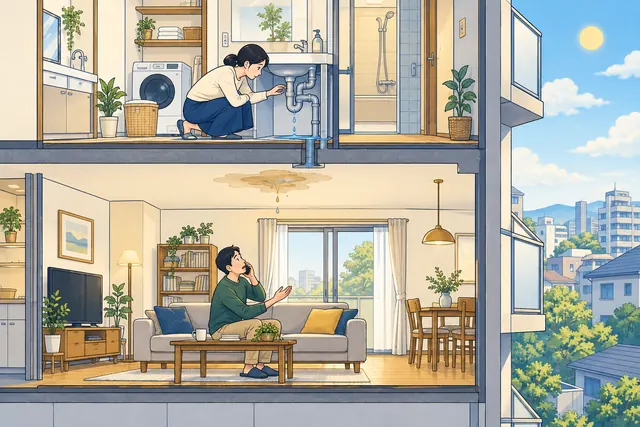
- 01
Keep away from wet electrical equipment and sagging ceilings
- 02
Contact the manager and ask whether the water can be shut off
- 03
Record the discovery time, water flow and affected area
An upper floor or shared area may also be involved
Repairs may extend beyond the leaking room. Coordinate upstairs contacts, shared pipes, and access through management. Do not blame neighbors before the cause is established.
When water can and cannot be shut off
If your unit’s main or shutoff valve is clearly identified and reachable from a dry, safe place, follow management guidance. Do not force shared equipment, stuck taps, or valves of unknown purpose.
Check repair costs before the visit
Check travel, inspection, night fees, parts, permanent repairs, and restoration after openings. Separate temporary shutoff from pipe replacement and interiors in quotes to assess additions.
Frequently asked questions about this topic
Does the upstairs resident pay?
It depends on cause, contracts and insurance. Share facts with management and your insurer rather than assigning responsibility yourselves.
FAQ and related guidance checked October 4, 2026. Ask relevant contacts about individual conditions, current acceptance, and programs.
Content errors, rights concerns or service information changes:Contact Kaneyoshi Miwa (Japan Product Management). Include the page URL and relevant passage. This is for routine inquiries, not emergency reporting.
What to learn next
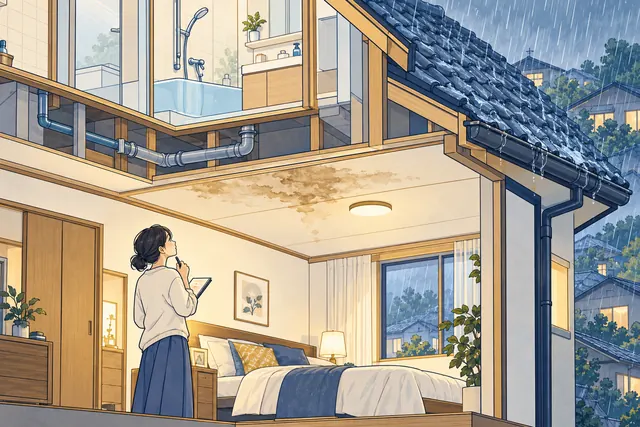
Does a ceiling stain always mean a rain leak?
Only on rainy days, or continuing in sunshine? Organize observations for inspectors without assuming the cause of ceiling stains.
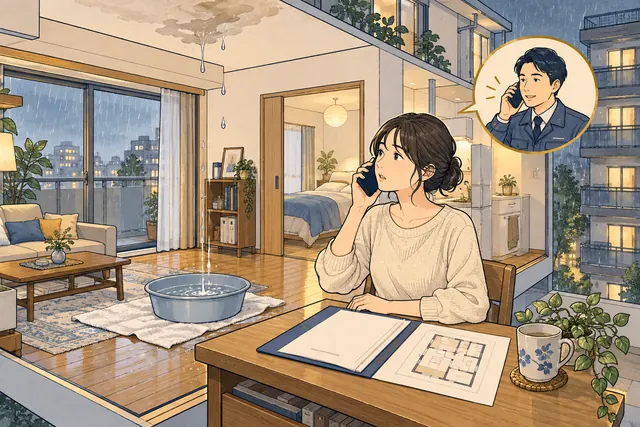
Rental rain or plumbing leaks, contacts before ordering repairs yourself.
When tenants notice problems: contacting management or landlords, photos, costs, and emergency actions.
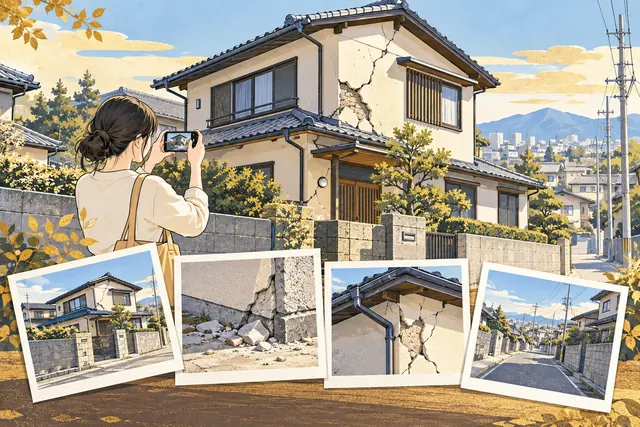
Pre-repair photos: building, location, close-ups, and wider views
Organize photos for provider consultations, damage records, and insurance checks. Avoid unsafe photography; show when, where, and what.
Things to know about housing in Japan
Rules differ by building and rental agreement. Ask your property manager or local municipality if you are unsure.
In a rented home, contact the manager before ordering repairs
Tell your property manager or landlord about the problem first. Before making your own contract, check who to contact, who pays and what work is covered.
Corridors and balconies may form part of an escape route
Keep shared corridors, balcony partitions (隔て板) and escape hatches (避難ハッチ) clear of belongings. Ask the property manager about your building's rules. Do not break partitions or open escape equipment for practice on your own.
An evacuation site and a shelter may serve different purposes
A designated emergency evacuation site (指定緊急避難場所) is a place to escape immediate disaster danger. A designated evacuation shelter (指定避難所) is a facility for staying after evacuation. Check the disaster type and your municipality's instructions.
Read current official disaster information in your language
JMA / English
Reference: Cabinet Office guidance on evacuation sites and shelters
Words used in this article
Short explanations, with the Japanese words you may hear in everyday life.
- Multi-unit housing 集合住宅(shuugou juutaku)
A building containing homes for several households, such as an apartment building.
Distinguish your own unit from shared areas and check building rules for repairs and evacuation.
- Warranty 保証(hoshou)
Conditions describing how certain problems after the work will be handled.
Check coverage, period, exclusions and contact details in writing; a warranty does not make every repair free.
- Restoration 復旧(fukkyuu)
Work to make something usable again after a disaster or other damage.
Check the necessary order with professionals, including safety checks, finding the cause and repairs.
- Property management company 管理会社(kanri gaisha)
A company appointed to manage a building and handle contact on the owner's behalf.
For a rented home or apartment building, check the contact details in your agreement or building notices.
- Local authority 自治体(jichitai / shikuchouson)
The administration of your city, ward, town, village or prefecture.
Use your area's official website or office to check evacuation sites and post-disaster procedures.
- Landlord 大家(ooya / kashinushi)
The person or company renting out a room or home.
Check whether repairs should be reported to the landlord or management company before arranging work yourself.
- Shared corridor 共用廊下(kyouyou rouka)
A passage used by multiple residents in a multi-unit building, sometimes also an escape route.
Check rules for belongings and bicycles and do not block passage or evacuation.
- Balcony partition panel 隔て板(hedateita / shikiri ita)
A panel between neighbouring balconies; some are designed as part of an emergency escape route.
Ask the manager whether it is for escape and how to use it; keep it clear and do not break it for practice.
- Emergency escape hatch 避難ハッチ(hinan hacchi)
A covered opening in a balcony floor or similar location used for escape to a lower floor.
Check building instructions with the manager, keep it clear, and do not open or descend it alone for practice.
- Emergency escape equipment 避難器具(hinan kigu)
Equipment such as ladders installed to help people escape a building in an emergency.
Ask the manager about its location and use beforehand, keep it clear, and do not open or descend it alone just to practise.
- Designated emergency evacuation site 指定緊急避難場所(shitei kinkyuu hinan basho)
A place officially designated for escaping an immediate disaster danger.
Sites are designated by disaster type. Check suitability for the current hazard, not just distance.
- Evacuation shelter 避難所(hinanjo / shitei hinanjo)
A facility where people unable to return home after a disaster can stay temporarily.
Its purpose differs from an immediate escape site. Check which shelters are open with local authorities.
Plain-language explanations by Tatemono Fukkyu Note. They are not an assessment of your building or an individual evacuation decision.